
ACP vs UCP: What Ecommerce Teams Need to Know
A practical comparison of OpenAI's Agentic Commerce Protocol and Google's Universal Commerce Protocol, including what is documented and what is still early.
Kaushik Mahorker
Co-founder & CEO
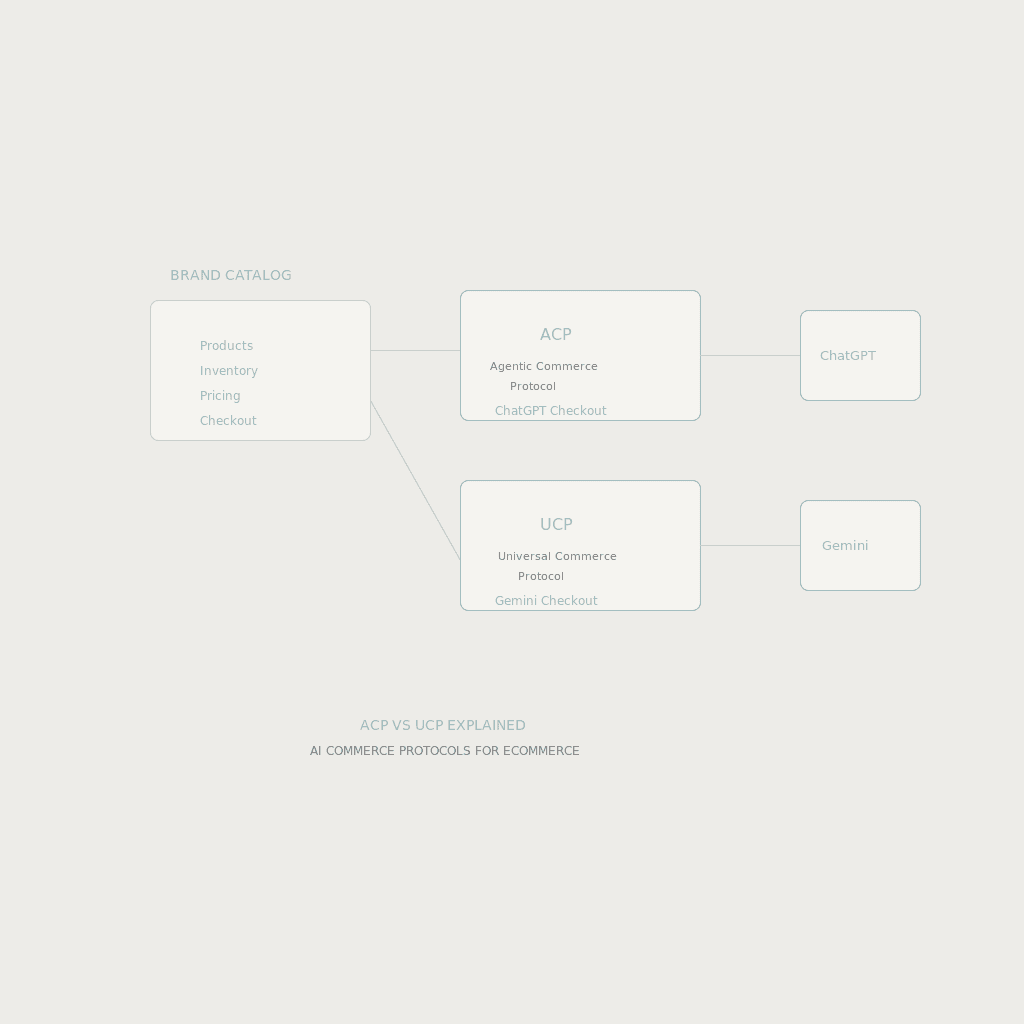
ACP and UCP are open commerce protocols from different ecosystems. ACP connects merchants with commerce experiences in ChatGPT. UCP defines commerce interactions for Google surfaces. Neither is a universal switch that makes a catalog purchasable across every AI assistant, and access can depend on merchant eligibility, market, product category, and rollout stage.
For ecommerce operators, the immediate work is not choosing a winner. It is understanding each protocol's requirements, fixing the catalog and checkout systems they depend on, and confirming what is actually available to your business.
ACP and UCP at a glance
| Question | ACP | UCP |
|---|---|---|
| Who maintains it? | OpenAI and Stripe introduced the protocol | Google introduced the protocol with commerce and payments partners |
| Primary documented context | Product discovery and checkout in ChatGPT | Discovery and checkout on supported Google AI surfaces |
| Merchant starting point | A product feed, then supported checkout capabilities | Merchant Center preparation, product data, policies, and supported checkout capabilities |
| Does it guarantee distribution? | No | No |
| Is availability uniform? | No. Merchant and feature access can vary | No. Surface, country, merchant, and feature access can vary |
The standards overlap, but their schemas, onboarding paths, and supported experiences are not interchangeable. Plan for separate technical and commercial reviews.
What ACP does
The Agentic Commerce Protocol is an open standard intended to connect merchants with ChatGPT commerce experiences. OpenAI's documentation separates two important jobs: supplying product information for discovery and supporting transaction flows where checkout is available.
Product discovery starts with the feed
OpenAI's ACP getting-started guide asks merchants to share a structured product feed. That feed needs accurate titles, descriptions, variants, prices, availability, images, and other product details.
A valid feed is an input, not a promise of placement. ChatGPT decides what to show for a given request. Merchants still need to monitor whether product facts are current and whether the resulting descriptions are accurate.
Checkout requires more than feed approval
The protocol also describes checkout sessions and merchant endpoints. The merchant remains responsible for core commerce operations such as pricing, inventory, tax, shipping, payment handling, order creation, and customer support.
Do not assume that product ingestion means checkout is live. Confirm the capabilities enabled for your account and market before designing launch plans around an in-chat purchase path.
What UCP does
The Universal Commerce Protocol is Google's open standard for commerce interactions on supported AI surfaces. Google's implementation guidance begins with Merchant Center readiness, including product data, shipping, and returns.
Merchant Center remains a core dependency
Google's UCP guides direct merchants to prepare their Merchant Center account and product feed. That makes existing feed operations relevant: identifiers, variants, availability, pricing, shipping, and return policy data need clear owners.
As with ACP, protocol readiness does not guarantee that a product will appear for a query or that every checkout feature is available.
UCP covers a broader commerce contract
UCP documentation describes merchant capabilities, checkout interactions, and order-related information. The useful operator takeaway is not that every documented capability is live everywhere. It is that Google is defining a contract that can extend beyond product retrieval into transaction and post-purchase work.
Treat the specification and your current merchant access as two separate facts. Build against the version and features you can test, not a roadmap assumption.
Where the protocols differ in practice
Onboarding is ecosystem-specific
ACP onboarding is tied to OpenAI's merchant process and ChatGPT commerce documentation. UCP implementation is tied to Google's merchant systems and supported surfaces. An ecommerce team may be eligible for one before the other.
Product data can share a source, not necessarily a format
Your PIM, commerce platform, or catalog service can remain the source of truth. The output still needs to meet each destination's schema, validation, refresh, and policy requirements.
This is where catalog enrichment matters. Missing dimensions, compatibility details, variant relationships, or policy information should be fixed at the source when possible, then mapped to each protocol.
Checkout needs separate acceptance testing
Do not treat a successful API response as a completed merchant journey. Test:
- Price and stock changes between discovery and checkout
- Variant selection and unavailable combinations
- Shipping addresses, rates, and delivery promises
- Taxes, discounts, and payment failures
- Order confirmation, cancellation, returns, and support handoff
The Instant Checkout overview explains the operational work behind these flows without assuming every destination is already enabled.
A sensible decision framework
Start with business access, not protocol enthusiasm.
- Confirm availability. Ask each provider what merchant program, countries, categories, and capabilities are available to you now.
- Map system ownership. Identify who owns the catalog, inventory, pricing, checkout, order management, support, and policy data.
- Assess the gap. Compare current systems with the documented feed and endpoint requirements.
- Stage the work. Feed readiness can be useful even when a transaction feature is not yet available.
- Test each surface independently. Do not infer one protocol's behavior from the other.
What not to conclude
The publication of an open protocol does not mean:
- Every merchant can activate it immediately
- Every documented capability is generally available
- Supporting one protocol provides automatic support for the other
- A valid integration guarantees recommendation, placement, or sales
- One provider's checkout behavior will match another's
Those distinctions keep a technical exploration from becoming an unsupported revenue forecast.
What to do this week
- Assign an owner to verify current ACP and UCP eligibility with the official merchant channels.
- Audit your top 25 SKUs for identifiers, variants, price, availability, shipping, returns, and complete product facts.
- Draw the system path from PIM to feed to checkout to order management, including the owner of each failure state.
- Write a test matrix for one product, one market, and one protocol before discussing a broad rollout.
- Add protocol availability and dependency risks to the ecommerce roadmap.
Sources
- OpenAI: Agentic Commerce Protocol
- OpenAI: Get started with ACP
- OpenAI: ACP key concepts
- Google: Universal Commerce Protocol
- Google: UCP implementation guides
- Google: UCP frequently asked questions
If you want a grounded starting point, run a free AI visibility audit before committing engineering time to a protocol rollout.
Keep reading
Related reading
See where your products appear.
Run a catalog audit, find the gaps, and choose the work most likely to change the answer.