
Amazon Rufus: AI Visibility Is the New Customer Acquisition Channel
Amazon Rufus gives shoppers another way to research products. Here is a practical catalog and listing playbook for Amazon operators.
Kaushik Mahorker
Co-founder & CEO
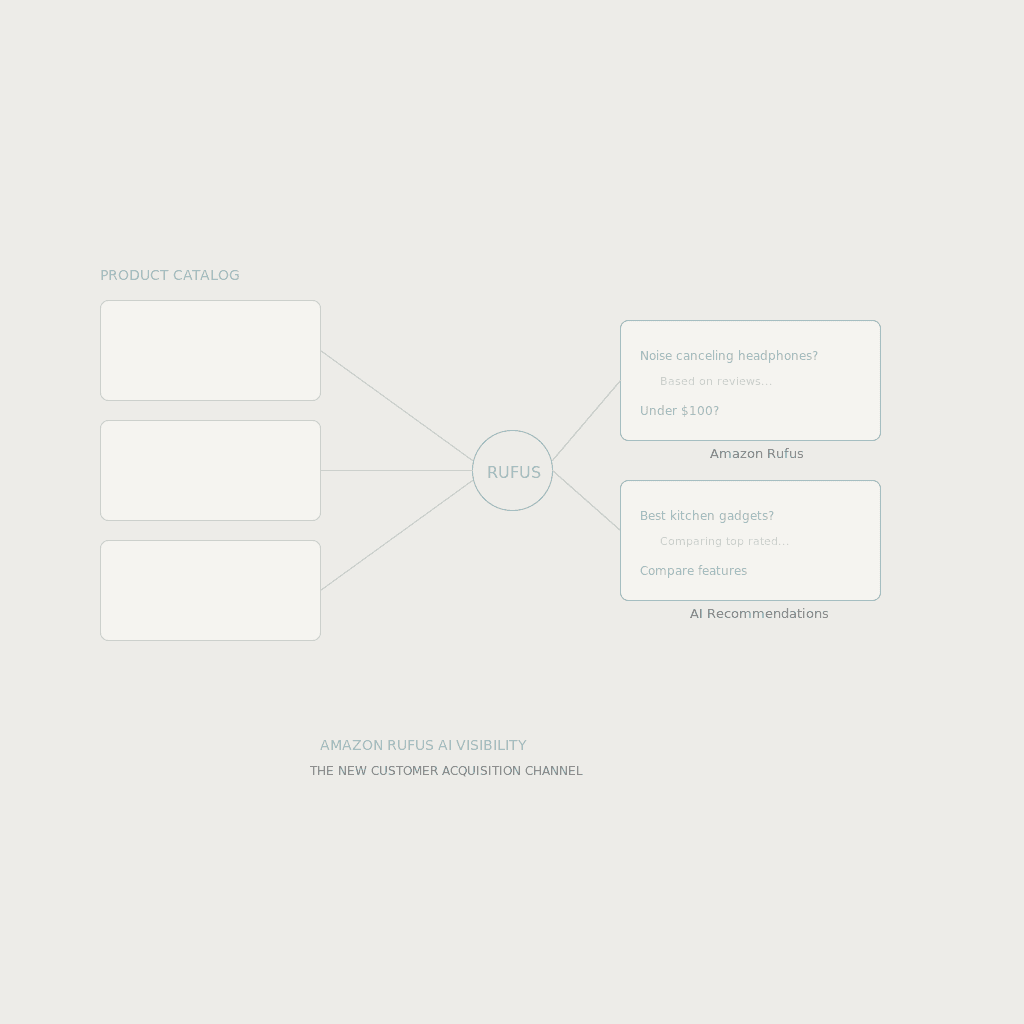
Amazon Rufus gives shoppers a conversational way to research products inside Amazon. For marketplace operators, the practical response is to improve the facts Rufus and shoppers can use: listing content, structured attributes, variants, reviews, questions, price, and availability.
Rufus does not make Amazon search obsolete, and its responses should not be treated as a fixed leaderboard. It adds another discovery path on top of the marketplace work sellers already do.
How Rufus changes the shopping session
A keyword search often starts with a product name or category. A Rufus conversation can start with a situation:
I need headphones for working from home, under $100, comfortable for long calls, with useful noise reduction.
That request combines budget, use case, comfort, and a feature requirement. The shopper can then ask follow-up questions without starting a new search.
For an operator, this is important because each constraint has to map to trustworthy product information. If comfort is only implied by marketing copy, or the exact battery life differs between bullets and images, the listing creates uncertainty for both the shopper and any system summarizing it.
Rufus coverage and response format can vary. It may not expose a stable rank, a full source list, or the same product set for every shopper. Use prompt checks to investigate listing quality, not to claim a permanent position.
Why Amazon teams should care
Rufus sits close to the product detail page and Amazon checkout. That makes the quality of marketplace data directly relevant to customer acquisition.
It creates intent-rich discovery
Conversational questions can include use cases that are awkward to express as short keywords. A camping product may be considered during a broader family-trip question. A kitchen tool may appear while a shopper plans a starter setup.
This does not guarantee incremental demand, but it gives operators another reason to describe products in terms customers actually use.
It exposes catalog inconsistencies
Amazon listings are assembled from titles, bullets, attributes, images, variation relationships, and other contributions. When those inputs disagree, a concise answer can surface the contradiction quickly. Treat this as a catalog-quality signal.
It connects merchandising and operations
The usefulness of a recommendation depends on more than copy. The selected variation needs to be available, correctly priced, and accurately described. The Rufus program therefore belongs in the marketplace operating rhythm, not in a standalone content project.
The Amazon-specific data to review
Start with the information you can control and verify. Do not rewrite every listing at once.
Titles and bullet points
Keep titles readable and compliant with Amazon requirements. Use bullets to state concrete product facts, primary use cases, compatibility, and meaningful limits. Remove repetition that adds keywords without adding information.
Structured attributes
Complete the category-relevant fields available for the ASIN. Dimensions, materials, size, age range, compatibility, included components, and care details can help distinguish products that otherwise look similar.
Use your catalog source as the authority. Wildcard's catalog enrichment page outlines a way to identify and manage missing product facts before they spread across channels.
Variation families
Check that parent-child relationships make sense to a shopper. Color and size variations should not combine products with materially different functions. Confirm that bullets, images, and attributes remain accurate when a shopper changes the selected child.
Images and A+ content
Images should support, not contradict, the listing. Use them to clarify scale, included items, fit, installation, and use. Keep critical specifications in maintained text and fields as well, rather than relying on an image alone.
Reviews and customer questions
Reviews and questions reveal the language customers use, recurring confusion, and product limitations. Follow Amazon policies for review collection and respond to questions accurately where the seller experience allows it.
Do not treat customer text as a substitute for verified product data. Use recurring themes to improve the product and listing.
Price and availability
Monitor suppressed offers, stranded inventory, variation-level availability, and unexpected price changes. Do not claim that any one of these factors directly controls Rufus inclusion without evidence. They still determine whether a surfaced product is useful and purchasable.
A Rufus operator playbook
1. Choose an ASIN cohort
Select 10 to 25 priority ASINs in one category. Include strong sellers, products with high consideration, and listings with known support questions. A small cohort makes before-and-after review possible.
2. Build Amazon-native questions
Use Amazon reviews, customer questions, search terms available to your team, and support conversations. Include specific constraints such as budget, fit, compatibility, household type, and intended use.
3. Capture a baseline
Run the question set where Rufus is available to you. Record whether the brand or ASIN appears, whether the explanation is accurate, and which constraints are answered. Save screenshots or notes with the date and context.
Wildcard's Amazon Rufus page provides more context on the surface. If you track prompts, remember that the output is an observation with variable coverage, not a guaranteed rank.
4. Compare answers with listing inputs
Trace inaccurate or missing facts back to the title, bullets, attributes, variation setup, images, and source catalog. Separate issues you can fix from behavior you cannot explain.
5. Ship compliant corrections
Update the source data and Amazon listing through your normal catalog process. Keep a record of what changed and why. Avoid unsupported superlatives and do not add a claim simply because a competitor uses it.
6. Review over time
Repeat the same core questions after changes have propagated. Look for patterns across several checks. Pair this with business metrics you already trust, but do not assign causation to Rufus without a defensible attribution path.
What not to do
- Do not replace Amazon SEO with Rufus-only optimization.
- Do not stuff conversational phrases into titles or bullets.
- Do not manufacture reviews, questions, comparisons, or product claims.
- Do not assume the first product mentioned holds a stable rank.
- Do not copy improvements to other channels without checking their field rules and customer context.
What to do this week
- Select 15 priority ASINs and five real customer questions for each product group.
- Run a focused catalog audit for missing or contradictory product facts.
- Check variation relationships, bullets, images, price, and availability for the cohort.
- Correct the three gaps most likely to confuse a shopper, using verified source data.
- Schedule a weekly Rufus review alongside the existing Amazon catalog meeting.
Sources
The original article included no external factual source links beyond the Wildcard site. Unsupported claims about Rufus adoption, conversion, shopper trust, and direct ranking factors have therefore been removed.
For one restrained next step, review the Wildcard product to see how catalog and visibility work can fit into the same marketplace workflow.
Keep reading
Related reading
Agent Automation
ACP vs UCP: What Ecommerce Teams Need to Know
Read articleAgent Automation
ChatGPT Apps and MCP Apps for Ecommerce Teams
Read articleSee where your products appear.
Run a catalog audit, find the gaps, and choose the work most likely to change the answer.