
ChatGPT Apps and MCP Apps for Ecommerce Teams
What ChatGPT apps and MCP mean for ecommerce teams, where portability stops, and how to scope a useful catalog or service integration.
Kaushik Mahorker
Co-founder & CEO
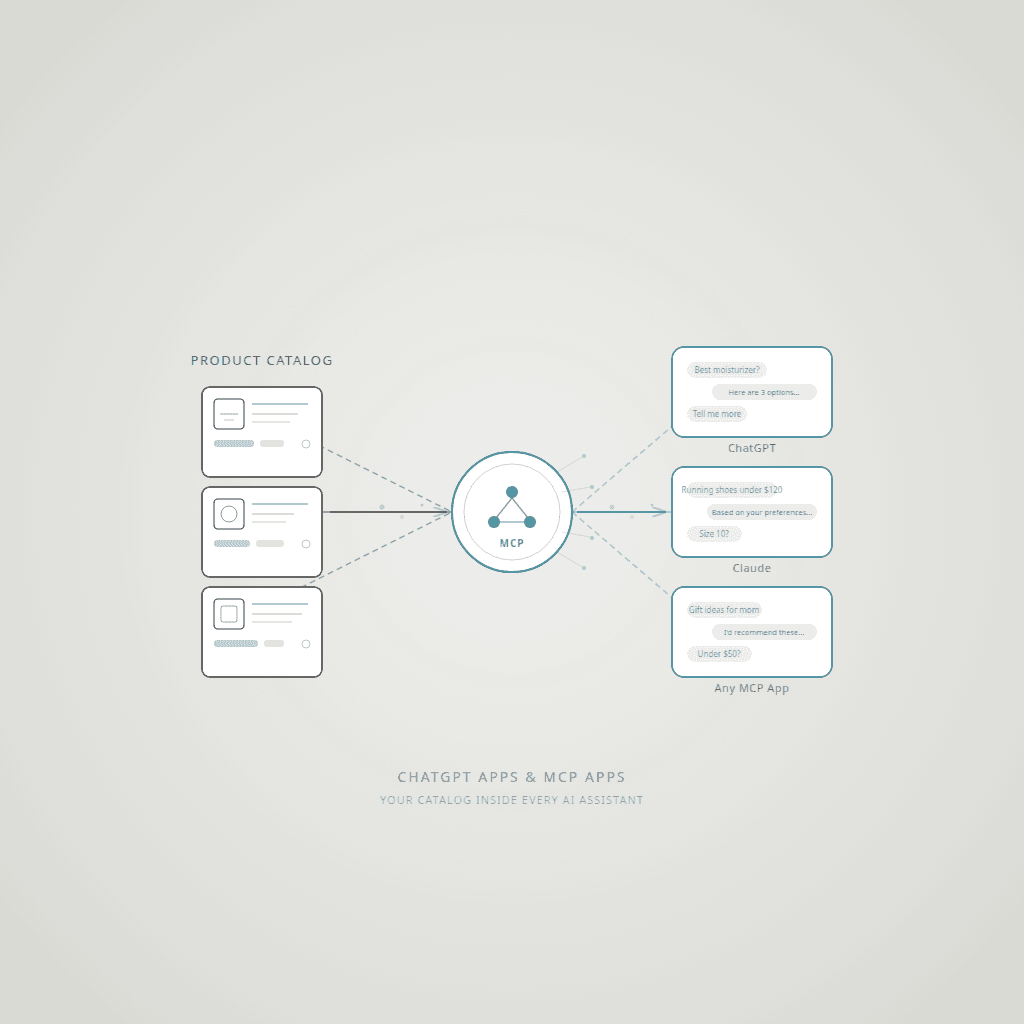
A ChatGPT app is an experience built for ChatGPT. MCP is the protocol used to connect that experience to tools and data. Using MCP can reduce integration work, but it does not make an app automatically portable, approved, discoverable, or commercially available in every AI product.
For ecommerce teams, the right question is not, "Do we need an MCP app?" Start with a customer job such as finding a compatible part, comparing ingredients, checking an order, or choosing the right size. Then decide whether ChatGPT is an appropriate surface and whether MCP is the right connection method.
ChatGPT apps and MCP are not the same thing
OpenAI's Apps SDK is its framework for building apps that run in ChatGPT. The app can expose tools, return structured results, and present an interface inside the conversation.
The Model Context Protocol is an open standard for connecting AI applications to external systems. An MCP server can describe tools and resources that a compatible client may call.
In OpenAI's architecture, MCP provides the connection between ChatGPT and the app's server. The ChatGPT app still has ChatGPT-specific work around interface behavior, authentication, review, distribution, policy, and testing.
What an ecommerce app can do
A useful app gives the model access to a narrow, controlled capability. Common ecommerce candidates include:
- Search a product catalog using natural-language constraints
- Retrieve approved product facts and variant details
- Check current price and availability
- Compare compatible products using defined fields
- Create a cart or hand off to checkout where supported
- Retrieve an order after authenticating the customer
- Explain shipping, returns, care, or warranty policies
These are tool calls, not permission for the model to invent an answer. Your server should return the facts needed for the task, reject unsupported requests, and preserve the business rules already enforced by your commerce systems.
Pick one customer job first
"Make our catalog available to AI" is too broad for a first release. A better brief is: "Help a shopper select the correct replacement filter for a named appliance model."
That scope tells the team which data is required, what counts as a correct answer, where authentication is needed, and when the app should decline or hand off to a person.
Why product data is still the hard part
MCP standardizes communication. It does not repair the catalog behind the tool.
If materials, ingredients, compatibility, dimensions, fit, or variant relationships are missing, the app cannot safely answer questions that depend on those facts. If price and inventory are stale, the app may create a poor handoff even when the tool call itself succeeds.
Start with the source of truth:
- Which system owns product identity?
- Which fields are approved for customer-facing use?
- How are variants and bundles represented?
- How quickly do price and inventory change?
- Which claims require legal or merchandising review?
- What should happen when two systems disagree?
The catalog enrichment workflow is relevant here because app quality depends on sourced product facts, not a longer system prompt.
Where MCP helps
A common tool contract
MCP gives clients and servers a documented way to describe tools, inputs, outputs, resources, and related metadata. That can make an internal catalog service easier to connect to more than one compatible client.
A cleaner boundary around business systems
The MCP server can sit between the model and systems such as the PIM, search service, commerce API, order service, or support knowledge base. That boundary is a good place to enforce authentication, input validation, rate limits, and field-level access.
Reuse of server-side logic
Some tool definitions and handlers may be reusable across clients. For example, a well-defined find_compatible_products tool can preserve the same validation and catalog query logic.
Where portability stops
"Build once, deploy everywhere" is not a safe planning assumption.
Different MCP clients can vary in:
- Supported protocol features and extensions
- Authentication and consent flows
- Interface rendering
- Tool approval and confirmation behavior
- Distribution and review requirements
- Rate limits, timeouts, and payload limits
- Commerce policies and transaction support
- Analytics and error reporting
OpenAI documents MCP Apps compatibility in ChatGPT, but compatibility with a protocol or UI standard is not the same as identical behavior across hosts. Test each target client and keep client-specific work in the estimate.
An operator's launch checklist
Define the task and refusal boundary
Write the exact user request the app should handle. Then write the requests it must refuse, clarify, or send elsewhere. For a skincare app, the boundary between product information and medical advice needs explicit treatment.
Design tools around decisions
Use tools with narrow names and clear input schemas. A tool called search_catalog may be too broad. A tool called find_products_by_verified_attributes makes the contract easier to inspect and test.
Return source fields, identifiers, and timestamps where they help the model explain the result accurately.
Treat writes as higher risk
Reading product information and placing an order are different risk classes. Cart changes, checkout initiation, account changes, cancellations, and returns need authentication, confirmation, idempotency, and audit records.
Test failure states
Include ambiguous requests, missing attributes, stale inventory, invalid variants, unavailable locations, expired sessions, partial service outages, and attempts to access another customer's order.
Plan ongoing operations
An app needs owners for catalog quality, tool changes, policy review, customer support, incident response, and measurement. Launch is the start of that work.
How to measure usefulness
Do not begin with app opens alone. Measure whether the app completes its intended job:
- Requests resolved without unsupported claims
- Clarification rate for ambiguous requests
- Product result relevance based on human review
- Out-of-stock or invalid-variant handoffs
- Cart or checkout handoffs where available
- Authentication and tool error rates
- Support escalations and correction themes
Use prompt tracking for repeated buyer questions and reporting to keep scope and changes visible. Neither measure proves that an app caused a sale without supporting commerce evidence.
What to do this week
- Choose one high-value customer job and write ten real requests for it.
- Audit the product and policy fields required to answer those requests without guessing.
- Draft two or three narrow tool contracts, including error and refusal responses.
- Review authentication, confirmation, and audit requirements before allowing any write action.
- Build a client-by-client test plan instead of assuming MCP portability.
Sources
- OpenAI: Apps SDK
- OpenAI: Apps SDK quickstart
- OpenAI: MCP in the Apps SDK
- OpenAI: MCP Apps compatibility in ChatGPT
- Model Context Protocol: Introduction
- Model Context Protocol: Architecture overview
If the customer job is clear and the data is ready, review Wildcard's ChatGPT Apps approach before you scope the first build.
Keep reading
Related reading
See where your products appear.
Run a catalog audit, find the gaps, and choose the work most likely to change the answer.